Florida’s Oldest Masonry Fort Has Guarded St. Augustine for More Than 350 Years
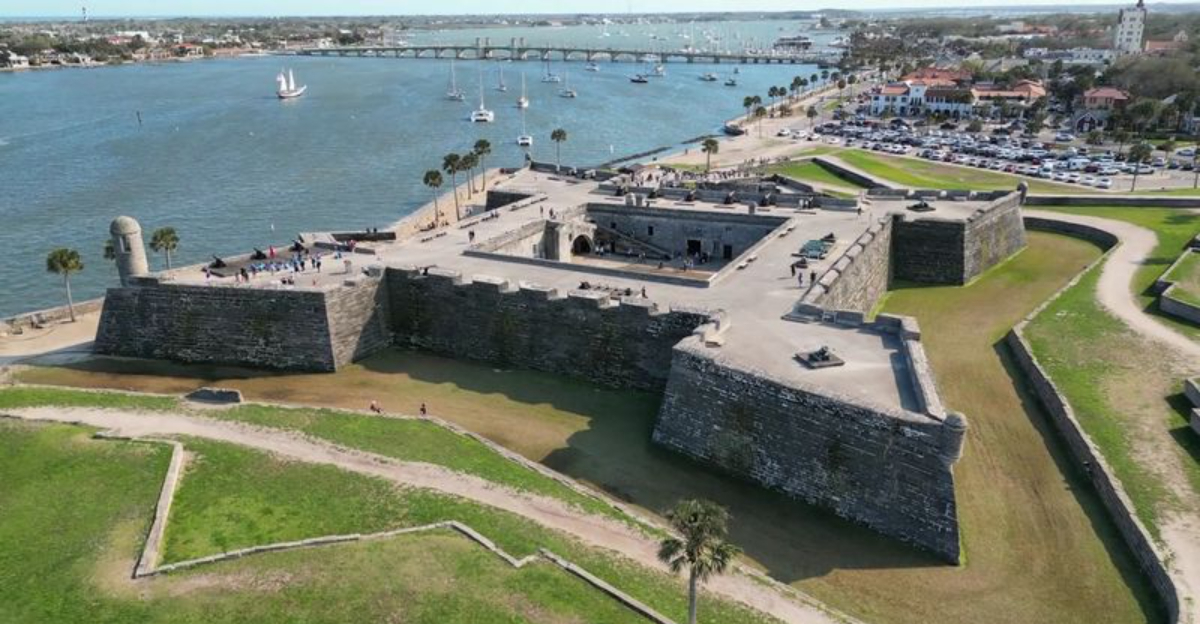
Standing strong against centuries of storms, sieges, and shifting empires, Castillo de San Marcos remains Florida’s most impressive Spanish colonial fortress. Built from coquina stone starting in 1672, this star-shaped military marvel has never fallen to enemy attack despite facing British cannons, American expansion, and the relentless Florida weather.
Walking across its drawbridge today feels like stepping into a time machine, where thick walls whisper stories of soldiers, prisoners, and the countless souls who shaped America’s oldest continuously occupied European settlement.
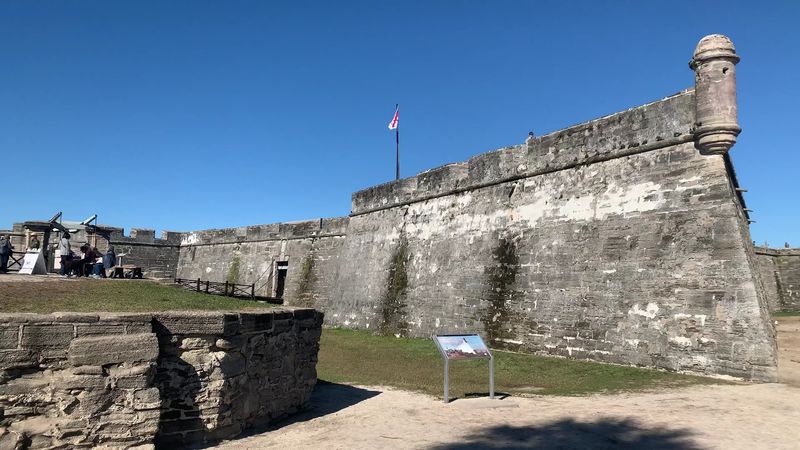
Coquina Stone Construction Made This Fort Virtually Indestructible
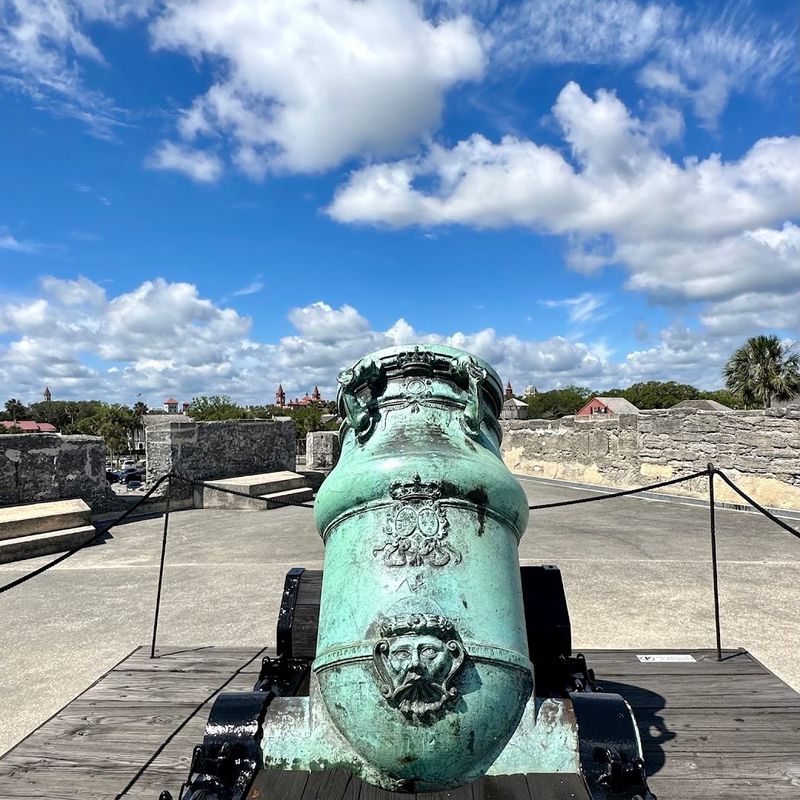
Most forts crumble under cannon fire, but Castillo de San Marcos developed a reputation for absorbing punishment like a sponge soaks up water. The secret weapon wasn’t military genius but geology.
Spanish engineers quarried coquina from nearby Anastasia Island, a sedimentary rock formed entirely from compressed seashells and coral.
When British cannonballs slammed into traditional stone fortifications, they shattered walls into flying shrapnel. Coquina behaved differently.
The soft, porous material actually absorbed the impact, with cannonballs embedding themselves harmlessly into the walls rather than blasting through. Some of those iron spheres remain lodged in the fort’s exterior today, silent testimony to failed sieges.
The construction process stretched across 23 years, from 1672 to 1695. Spanish laborers, enslaved Africans, and indigenous workers hauled thousands of coquina blocks from quarries across Matanzas Bay.
They mixed the stones with lime mortar, creating walls up to 12 feet thick at the base. The entire structure cost the Spanish Crown about 138,375 pesos, an astronomical sum that nearly bankrupted Florida’s colonial treasury.
Walking through the fort today, you can run your hands along these shell-embedded walls and feel the tiny fossilized creatures that became armor. The coquina’s natural drainage properties prevented water damage that destroyed other period fortresses.
Rain simply filtered through the porous stone instead of pooling and causing structural decay. This accidental engineering brilliance means the fort looks remarkably similar to how Spanish soldiers saw it three centuries ago, making it America’s oldest standing masonry fortification and a living textbook on colonial military architecture.
The Star-Shaped Design Revolutionized Colonial Defense Strategy
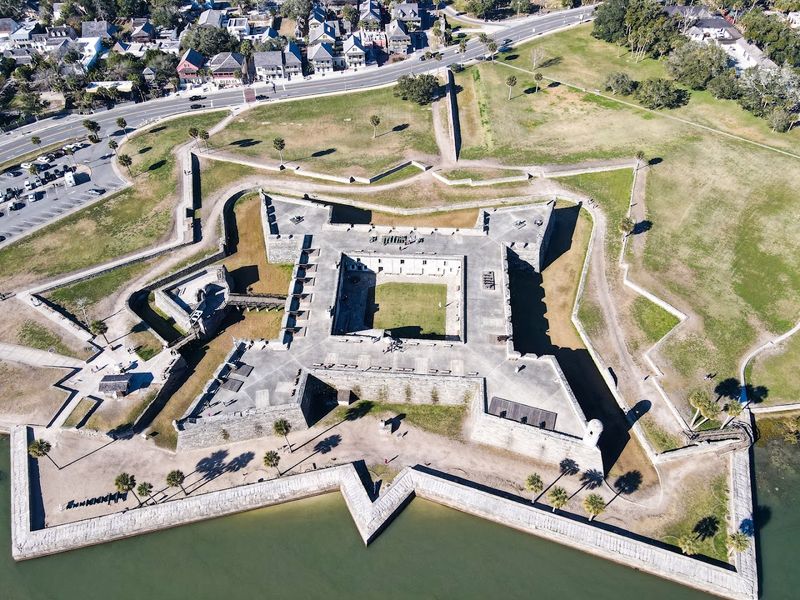
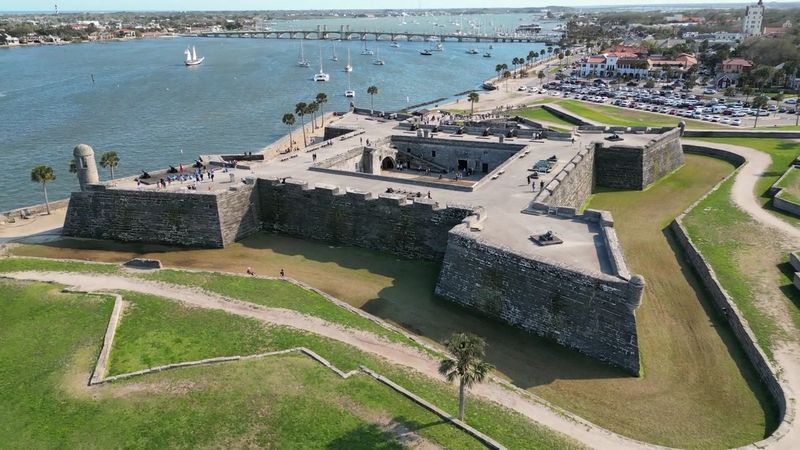
From above, Castillo de San Marcos resembles a four-pointed star, each corner jutting outward in diamond-shaped bastions. This wasn’t artistic flair but cutting-edge 17th-century military technology.
The design eliminated defensive blind spots that plagued medieval square castles, where attackers could huddle against walls beyond the reach of defenders’ muskets and cannons.
Each bastion could cover the walls of its neighbors with overlapping fields of fire. Soldiers positioned at one corner could shoot along the entire length of adjacent walls, creating a deadly crossfire zone.
Any enemy force attempting to scale the walls or plant explosives faced gunfire from multiple angles simultaneously. Spanish military engineers called this the trace italienne system, borrowed from Renaissance Italian fortress designs.
The fort’s layout includes four bastions named San Pedro, San Agustin, San Carlos, and San Pablo, each mounting multiple cannons pointed toward different approach vectors. The courtyard they protected measured roughly 100 feet square, providing shelter for soldiers, supplies, and desperate townspeople during attacks.
During the 1740 British siege, over 1,000 people crowded into this space for 38 days.
Modern visitors climbing to the gun deck gain the same commanding perspective Spanish sentries enjoyed. You can see how the bastions project outward, understand why attackers never breached these walls, and appreciate the mathematical precision behind placement of every cannon port.
The National Park Service has restored many of the original bronze and iron cannons to their historical positions, some still aimed across Matanzas Bay as if the British fleet might return any moment.
Matanzas Bay Views From the Gun Deck Showcase Strategic Military Positioning
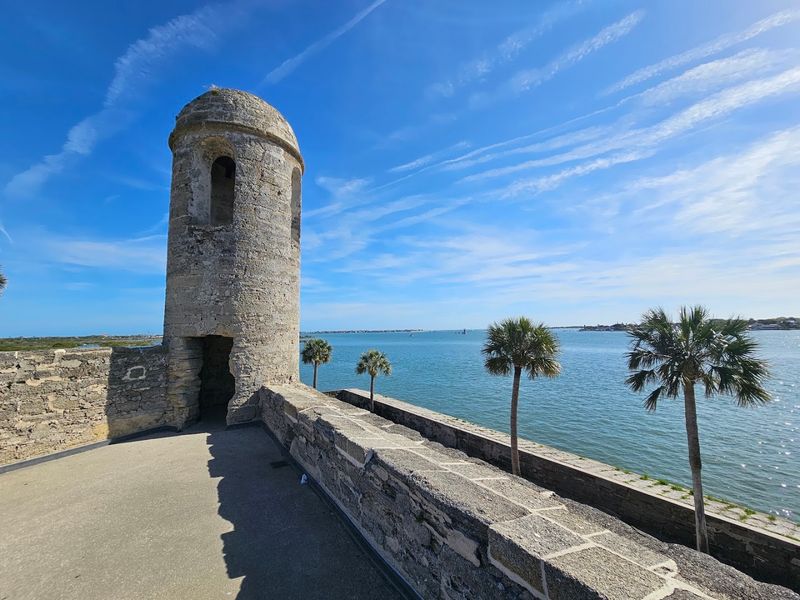
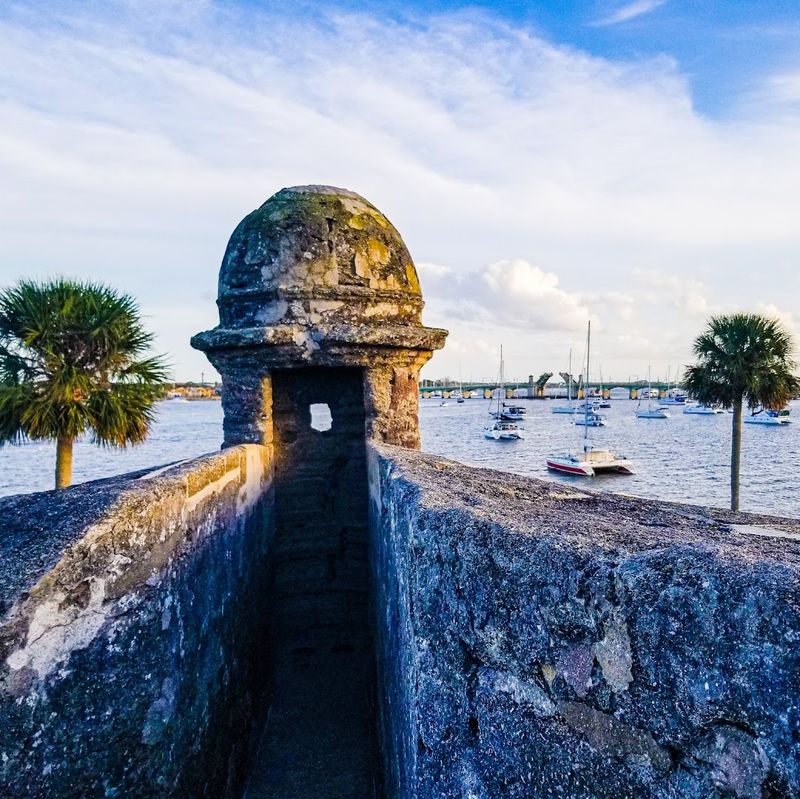
Climbing the stone ramp to the fort’s upper gun deck rewards you with sweeping vistas across Matanzas Bay, the same waterway Spanish lookouts monitored for approaching enemy vessels. The strategic brilliance becomes obvious from this elevated vantage point.
Any ship attempting to enter St. Augustine’s harbor had to sail directly past the fort’s cannons, running a gauntlet of potential destruction.
The gun deck stretches around the fort’s entire perimeter, with restored cannons positioned at regular intervals along the parapet. Park rangers occasionally demonstrate 18th-century firing procedures during special events, and the thunderous boom echoes across downtown St. Augustine, startling tourists sipping coffee at waterfront cafes.
Even without live ammunition, these demonstrations convey the psychological terror such bombardments inflicted.
Beyond military history, the views simply stun. Matanzas Bay sparkles in Florida sunshine, dotted with sailboats and fishing vessels navigating the same channels Spanish galleons once traveled.
The Bridge of Lions stretches across the water to the east, connecting downtown to Anastasia Island. Looking west, you see St. Augustine’s historic district spreading outward, red-tile roofs and church steeples marking the nation’s oldest continuously inhabited European settlement.
Benches line sections of the gun deck, inviting visitors to sit and absorb the scenery. Many reviewers mention spending hours up here, feeling breezes off the bay while imagining centuries of history unfolding below.
Sunrise and sunset transform the experience, painting the sky in colors that make even amateur photographers look professional. Just remember that Florida sun reflects intensely off the stone surfaces, so sunscreen and water bottles aren’t optional accessories but survival equipment for summer visits.
Interior Rooms Reveal Daily Life for Spanish Colonial Soldiers
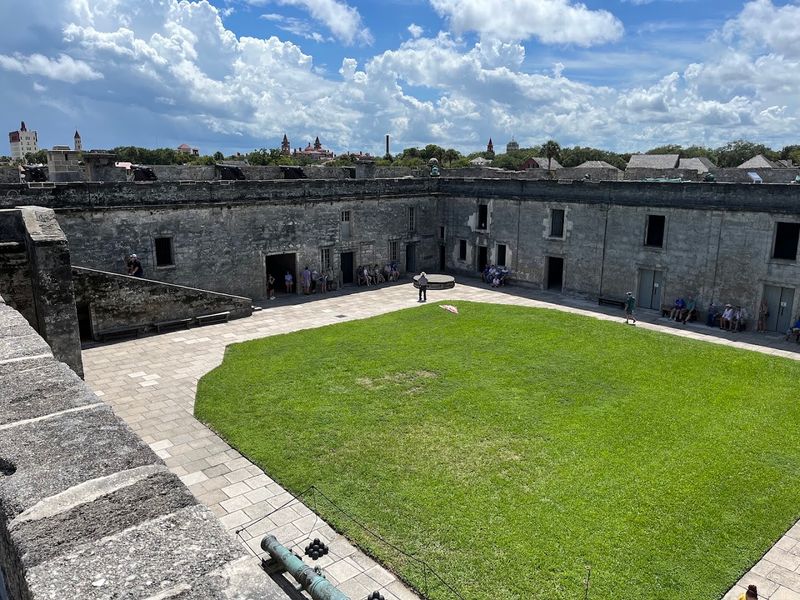
Descending from the sunny gun deck into the fort’s lower chambers feels like entering a different world entirely. These cool, shadowy rooms housed the soldiers, supplies, and support systems that kept the garrison functioning through decades of isolation from Spain.
Thick coquina walls maintain surprisingly comfortable temperatures even during brutal Florida summers, providing natural climate control that modern air conditioning struggles to match.
The fort contained barracks, a chapel, storage magazines, a kitchen, and even a prison. Walking through these spaces today, enhanced by National Park Service exhibits, brings three centuries of military life into focus.
Mannequins dressed in period uniforms stand guard, while display cases showcase artifacts recovered during archaeological excavations—musket balls, pottery fragments, uniform buttons, and personal items soldiers carried across the Atlantic.
One particularly moving exhibit recreates the chapel where soldiers attended Mass, married local women, and baptized children born within the fort’s protective walls. Another room demonstrates how the powder magazine stored thousands of pounds of gunpowder in conditions designed to prevent accidental explosions.
The kitchen area shows massive fireplaces where cooks prepared meals for garrisons that sometimes exceeded 300 men, plus their families.
Perhaps most sobering are the cells where the fort served as a military prison during its later American period. Seminole leaders including Osceola were imprisoned here during the 1830s, and Plains Indians like Geronimo’s fellow Apache warriors spent years confined in these chambers during the 1880s.
These darker chapters complicate the fort’s history, reminding visitors that this architectural marvel also witnessed suffering and injustice alongside military glory and engineering achievement.
Living History Demonstrations and Cannon Firings Bring the Past to Life
History textbooks can’t compete with the visceral thrill of watching a costumed interpreter ram powder down a cannon barrel, shout firing commands in Spanish, and touch a burning fuse to the touchhole. The resulting explosion rattles your ribcage, produces a massive cloud of white smoke, and temporarily deafens everyone within fifty yards.
These weekend demonstrations happen at 1:30, 2:30, and 3:30 PM, drawing crowds that pack the courtyard in anticipation.
The fort’s volunteer program deserves enormous credit for these immersive experiences. Passionate history enthusiasts dress in meticulously researched period uniforms, explaining everything from musket loading procedures to the daily ration allowances for 18th-century soldiers.
They answer questions with encyclopedic knowledge, often sharing details about specific sieges, individual commanders, or architectural features that formal exhibits can’t accommodate.
Beyond cannon demonstrations, living history weekends feature additional programming. You might encounter interpreters portraying Spanish wives doing laundry, craftsmen repairing muskets, or officers reviewing maps of colonial Florida.
A dress-up area lets children try on reproduction military gear, transforming restless kids into engaged junior historians. The Junior Ranger program provides age-appropriate activity booklets that turn fort exploration into an educational scavenger hunt.
These programs transform static architecture into dynamic storytelling. Instead of just seeing old cannons, you understand the coordinated teamwork required to operate them under combat conditions.
Rather than simply walking through empty rooms, you visualize families huddled here during sieges, soldiers standing watch through humid nights, and the complex human drama that unfolded within these walls. The National Park Service has mastered the art of making history accessible without dumbing it down, creating experiences that educate eight-year-olds and retired professors simultaneously.
The Fort Never Fell to Enemy Attack Despite Multiple Sieges
Military historians consider Castillo de San Marcos virtually unique among American fortifications because it never surrendered to enemy force. The fort changed hands multiple times, but always through treaties and diplomatic agreements rather than battlefield defeat.
This unblemished defensive record stems from the combination of superior construction, strategic positioning, and occasional good luck that characterized its military career.
The most famous test came in 1740 when British General James Oglethorpe led a massive invasion from Georgia with 2,000 troops and seven warships. Spanish Governor Manuel de Montiano retreated behind the fort’s walls with his garrison and about 1,000 townspeople.
Oglethorpe’s cannons pounded the coquina walls for 38 days, achieving nothing except embedding iron balls into the absorbent stone. His naval blockade failed when Spanish supply ships slipped through.
Finally, with his own supplies exhausted and disease spreading through his camp, Oglethorpe withdrew in humiliation.
Earlier British sieges in 1702 and 1728 produced similar results. The fort’s design made direct assault suicidal, while its position prevented easy encirclement.
The Spanish maintained supply lines by sea, meaning besieging armies faced starvation before the defenders did. When Spain finally ceded Florida to Britain in 1763, the exchange happened through the Treaty of Paris, not military conquest.
Later transfers between Britain, Spain, and the United States all occurred through diplomatic channels.
This defensive perfection matters because it validates the engineering principles behind the fort’s construction. The Spanish Crown’s massive investment in coquina walls and bastion design proved justified.
Walking these ramparts today, you’re exploring a fortress that fulfilled its purpose flawlessly, protecting Spanish Florida’s capital through a century of imperial warfare and emerging structurally intact.
Practical Visitor Information Makes Planning Your Visit Straightforward
Castillo de San Marcos operates daily from 9 AM to 5 PM, managed by the National Park Service as a National Monument. Admission costs $15 for adults, with children 15 and under entering free.
The pass remains valid for seven consecutive days, allowing multiple visits if you’re spending extended time in St. Augustine. America the Beautiful Pass holders enter without additional charge, making the annual $80 pass an excellent value for anyone visiting multiple national parks.
Parking presents the biggest logistical challenge. The small lot directly in front of the fort charges $2.50 per hour and fills quickly, especially during peak season and weekends.
Many visitors park in the large municipal garage across the street, which offers shade and easier availability but similar hourly rates. Downtown St. Augustine’s compact layout makes walking from hotels a viable option—several reviewers mentioned pleasant 15-20 minute strolls along the waterfront.
The fort’s hard surfaces and stairs present accessibility considerations. The courtyard and lower level rooms are wheelchair accessible, but reaching the gun deck requires climbing stone ramps and stairs without elevator alternatives.
Staff members at the entrance provide detailed accessibility information and can suggest modified touring routes. Clean, air-conditioned restrooms are available inside the fort, though no facilities exist outside the paid admission area.
Summer visits demand serious sun protection. The stone surfaces reflect heat intensely, and shade is limited on the gun deck.
Bring water bottles, wear sunscreen, and consider visiting during morning hours before peak heat. Conversely, winter months offer comfortable temperatures and smaller crowds, though you’ll miss some living history programming.
The fort’s location in downtown St. Augustine puts you within walking distance of dozens of restaurants, shops, and other historic attractions, making it easy to build a full day around your visit to Florida’s most impressive colonial fortress.